Sports assessment and therapy
Measured before the season, not after the injury.
Functional movement assessments, core stability screening, range of motion and flexibility testing, and dynamic strength and proprioception work, followed by injury prevention training, sport-specific training, throwing programs and strength programs.
Chapter 01
Assessment before injury, which is the whole point
The assessment side of this service exists so an athlete does not have to get hurt first in order to get looked at. It runs functional movement assessments, core stability screening, general range of motion and flexibility testing, and dynamic strength and proprioception testing.
Proprioception is the one worth explaining, because it is the one that quietly ends seasons. It is your sense of where a joint is without looking at it, it degrades after an injury, and it does not come back on its own just because the swelling went down. An ankle that feels fine and still rolls is usually a proprioception problem, not a strength problem.
Screening also produces something useful when nothing is wrong: a baseline. If an injury happens in October, a set of numbers from August is worth considerably more than a guess about what normal used to look like.
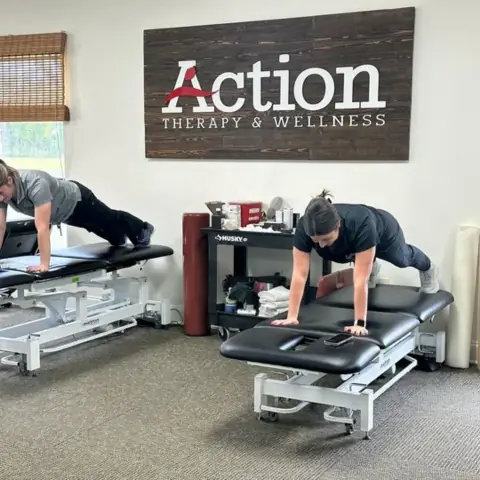
Action Therapy staff holding plank positions on treatment tables inside the Gonzales clinic
Throwing programs and getting back to the actual sport
Programming covers injury prevention training, sport-specific training, throwing programs and strength programs, plus injury prevention information for athletes across sports.
A throwing program is a staged return rather than a rest period followed by a game. Volume and intensity climb on a schedule, and the schedule exists precisely so that feeling good on a Tuesday does not turn into a hundred pitches on a Wednesday.
The same logic applies to every sport we see. Return to play is planned from the first visit and adjusted against what the athlete can actually do, not against the date somebody hoped for.
Chapter 03
Who this is genuinely for
Taylor Terrio, PTA, earned a Bachelor of Science in Kinesiology at the University of Louisiana at Lafayette and competed as a Division 1 collegiate softball student-athlete for four years before completing her Physical Therapy Assistant degree at Franciscan Missionaries of Our Lady University. She is certified in Kinesio taping and pain science education.
That background is useful in the room in a specific way. A teenager deciding whether to admit how much something hurts tends to answer differently when the person asking has been on the other side of the question.
This is not a service reserved for college prospects. Rec league adults, high school athletes and anyone who has decided to start training seriously are all in scope, and the assessment is the same either way.
Over 30 years of combined experience. Call (225) 644-7044 and you will be contacted within 24 hours.